𝐌𝐈𝐋𝐄𝐒𝐓𝐎𝐍𝐄𝐒 | 𝐇𝐨𝐥𝐝𝐢𝐧𝐠 𝐭𝐡𝐞 𝐋𝐢𝐧𝐞, 𝐑𝐚𝐢𝐬𝐢𝐧𝐠 𝐭𝐡𝐞 𝐁𝐚𝐫: 𝐓𝐀𝐔 𝐫𝐞𝐭𝐚𝐢𝐧𝐬 𝐓𝐇𝐄 𝐒𝐮𝐬𝐭𝐚𝐢𝐧𝐚𝐛𝐢𝐥𝐢𝐭𝐲 𝐈𝐦𝐩𝐚𝐜𝐭 𝐑𝐚𝐭𝐢𝐧𝐠𝐬
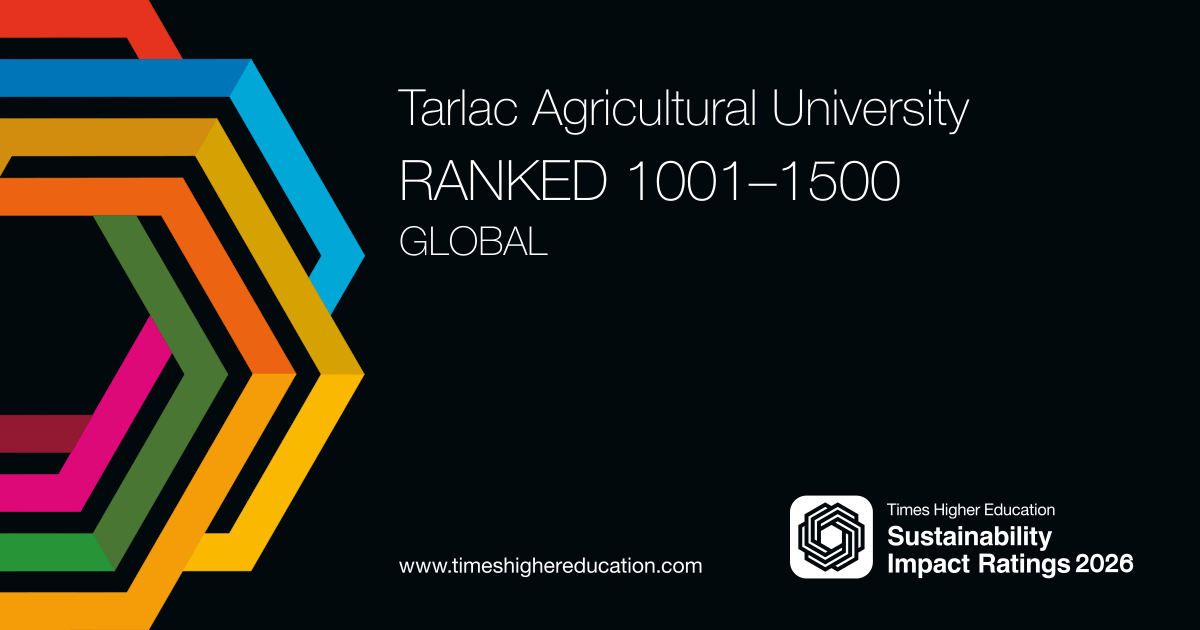
Tarlac Agricultural University (TAU) has once again reaffirmed its commitment to the global sustainability agenda, as revealed in the newly released 2026 Times Higher Education (THE) Sustainability Impact Ratings. While maintaining its overall global standing within the 1001–1500 bracket, TAU showcased exceptional specialization across four critical Sustainable Development Goals (SDGs).
The University's overall score stood at 52.1 in 2026, following its 55.7 rating in 2025. This institutional stability is particularly remarkable given the growing national and global competition, as more institutions join the rigorous rankings each year. TAU's ability to hold its ground while focusing on specialized SDGs demonstrates that targeted excellence can offset broader macro-fluctuations, a strategy that has anchored the University well since its ranking debut in 2021.
𝐙𝐞𝐫𝐨 𝐇𝐮𝐧𝐠𝐞𝐫, 𝐄𝐜𝐨𝐬𝐲𝐬𝐭𝐞𝐦𝐬, 𝐚𝐧𝐝 𝐄𝐪𝐮𝐢𝐭𝐲: 𝐓𝐡𝐞 𝐒𝐃𝐆 𝐁𝐫𝐞𝐚𝐤𝐝𝐨𝐰𝐧
The University's most remarkable achievement this cycle is its performance in SDG 2 (Zero Hunger), where it secured a prestigious global rank of 201–300 with an impressive score of 57.4. This represents a significant leap from its 401–600 ranking in 2025, underscoring TAU's intensifying impact on food security and agricultural research.
As an institution deeply rooted in agricultural development, this top-tier placement validates the University's ongoing research into crop resilience, sustainable farming techniques, and proactive community extension programs. The upward trajectory in SDG 2 reflects the administration's strategic prioritization of agricultural innovation, successfully translating academic expertise into tangible solutions for hunger and malnutrition in Tarlac and neighboring provinces.
Equally notable is TAU's performance in SDG 15 (Life on Land), where it achieved a rank of 301–500 with a score of 54.6. This high standing highlights the University's active commitment to protecting terrestrial ecosystems, promoting biodiversity within agricultural landscapes, and advancing sustainable land management practices.
In the realm of SDG 5 (Gender Equality), TAU secured a rank of 401–600 with a score of 51.1, a minor adjustment from its outstanding 301–400 ranking in 2025. Despite this slight dip, the University remains a strong institutional advocate for inclusive policies, women's empowerment, and equal opportunities across both academia and leadership.
For SDG 17 (Partnerships for the Goals), TAU climbed into the 1001–1500 bracket with a score of 42.1, marking a significant improvement from its 1501+ ranking in 2025. This upward movement signals strong progress in building cross-sectoral collaborations, expanding international research networks, and strengthening institutional governance structures.
𝐌𝐚𝐩𝐩𝐢𝐧𝐠 𝐅𝐮𝐭𝐮𝐫𝐞 𝐇𝐨𝐫𝐢𝐳𝐨𝐧𝐬
A broader examination of TAU's 2026 performance across the remaining indicators reveals a well-rounded institution with a solid foundation for strategic growth. TAU recorded steady placements in the 401–600 bracket for multiple SDGs: SDG 1: No Poverty; SDG 6: Clean Water and Sanitation; SDG 7: Affordable and Clean Energy; SDG 12: Responsible Consumption and Production; and SDG 13: Climate Action.
Conversely, the performance data also identifies areas for potential future development, particularly within SDG 3 (Good Health and Well-being), SDG 4 (Quality Education), SDG 8 (Decent Work and Economic Growth), SDG 9 (Industry, Innovation, and Infrastructure), SDG 10 (Reduced Inequalities), SDG 11 (Sustainable Cities and Communities), and SDG 16 (Peace, Justice, and Strong Institutions).
𝐆𝐥𝐨𝐛𝐚𝐥 𝐑𝐞𝐩𝐫𝐞𝐬𝐞𝐧𝐭𝐚𝐭𝐢𝐨𝐧 𝐢𝐧 𝐉𝐚𝐤𝐚𝐫𝐭𝐚
This commitment to the global agenda was further spotlighted as University President Dr. Silverio Ramon DC. Salunson joined the official Philippine Delegation at the prestigious THE Global Sustainable Development Congress 2026.
Held in Jakarta, Indonesia from 22 to 25 June, the Filipino representatives were spearheaded by the Commission on Higher Education (CHED) and co-hosted by the Southeast Asian Ministers of Education Organization (SEAMEO).
Ultimately, TAU’s performance in the THE Sustainability Impact Ratings 2026 solidifies its reputation as a specialized trailblazer in sustainable agriculture and environmental stewardship. The University's trajectory illustrates a mature balance of steady institutional resilience and sharp, targeted growth. As it navigates an increasingly competitive global academic landscape, TAU remains focused on its mission to drive meaningful, real-world development across the Philippines and the world, one SDG at a time.
#SmartTAU #GreenandGlobal #THE #Sustainability #ImpactRatings #SDG4 #SDG9 #SDG17
Text | Jerome L. Duque [Information Unit]
Coordination | Dr. Sheila R. Lingaya [External Linkages and International Affairs]
Graphics | Times Higher Education